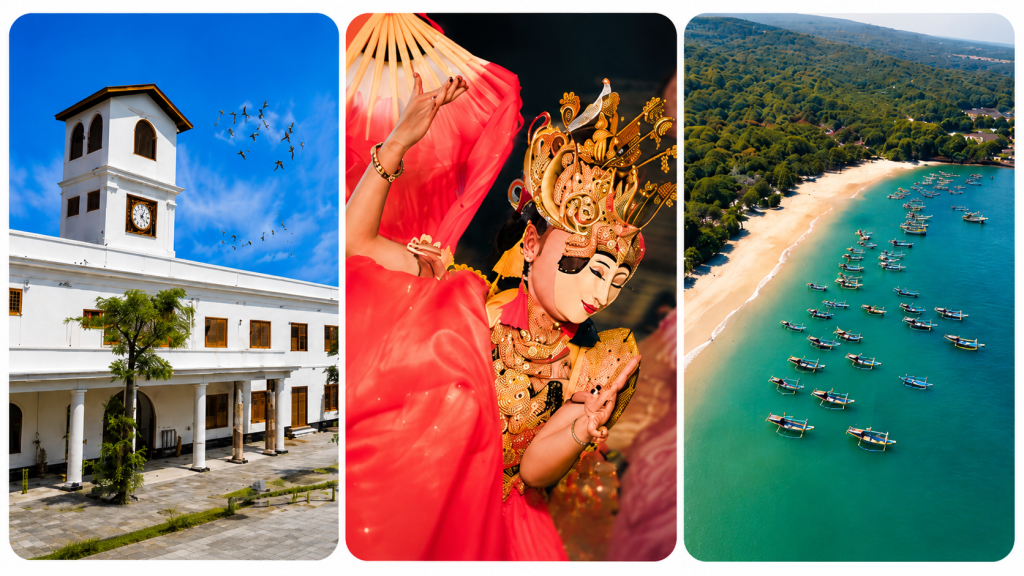
East Java is quietly becoming one of Indonesia’s most dynamic tourism regions. In 2025, it ranked #1st nationally for domestic visitor volume and #4th for foreign arrivals. This momentum has been supported by world-famous attractions such as Mount Bromo, Ijen Crater, and Tumpak Sewu Waterfall, alongside improved air and rail connectivity.
Yet growth remains uneven. Visitors are concentrated in a few key destinations, hotel occupancy is volatile, and the international market is still narrow compared with neighbouring Bali. Realising East Java’s full tourism potential requires a deeper understanding of its visitors and how to reach them.
A Market on the Rise
| #1 / #4 | East Java’s national rank for domestic/international visitors (2025) |
| 15.38M | International visitors to Indonesia in 2025, the share of East Java is growing |
| 16.13M | domestic trips to East Java in February 2026 alone |
These figures highlight East Java’s position as one of Indonesia’s leading tourism destinations. In 2025, accommodation and food service activities generated approximately Rp208.5 trillion, equivalent to around 6.13% of East Java’s total PDRB.
Where Visitors Are Coming From
International arrivals to East Java are dominated by Asian markets, with China, Malaysia, and Singapore emerging as the leading sources in early 2026. At the destination level, visitor profiles vary considerably. For example, Ijen Crater attracted large numbers of Russian and Chinese hikers throughout 2025.
Destinations Driving Demand
- Mount Bromo (Bromo Tengger Semeru): East Java’s iconic volcanic sunrise, boosted by growing international media exposure.
- Ijen Crater (Banyuwangi): renowned worldwide for its blue fire and turquoise acid lake.
- Tumpak Sewu Waterfall (Lumajang): more than 95,000 foreign visitors in 2025.
Trends Shaping 2026
Indonesia’s tourism ministry has highlighted 6 key trends for 2026: cultural immersion, eco-friendly tourism, nature and adventure travel, culinary and gastro-tourism, wellness tourism, and bleisure (business plus leisure). With its volcanoes, heritage sites, and celebrated cuisine, East Java is well placed to capture all six Indonesian tourism trends. Sustainability is also becoming a priority, with nearly seven in ten travelers wanting their trips to benefit the environment.
What Riset Prima Asia Did for East Java Tourism 2026 Landscape
Riset Prima Asia conducted an end-to-end tourism market study for the East Java provincial government. Using a mixed-methods approach, the team combined official statistics from BPS, the Ministry of Tourism, and UN Tourism as secondary research. Primary research consisted of a 600-respondent intercept survey conducted across 10 key destinations and arrival gateways. The survey prioritized international travelers and profiled them across demographic, geographic, psychographic, and behavioral dimensions. The research was complemented by focus group discussions with local government representatives, hoteliers, tour operators, and tourism associations.
Key Insights & Deliverables
The study turned raw tourism findings into strategy. It produced visitor personas, mapped priority and underdeveloped markets, benchmarked East Java against comparable destinations, and assessed the effectiveness of existing promotion. The government received an implementation-ready roadmap to sharpen targeting, strengthen destination marketing, and distribute visitors and spending more evenly across the province.
Discover East Java in 2026
With rising arrivals, expanding connectivity, and a diverse portfolio of natural and cultural attractions, East Java’s tourism sector is set for continued growth. Stay curious, and let’s explore East Java more!
Visit our website to explore more research, insights, and case studies.